We found a parasite where the entire DNA strand acts like a docking station for cell division, rather than just one spot.
bioRxiv · March 13, 2026 · 2025.09.30.679541
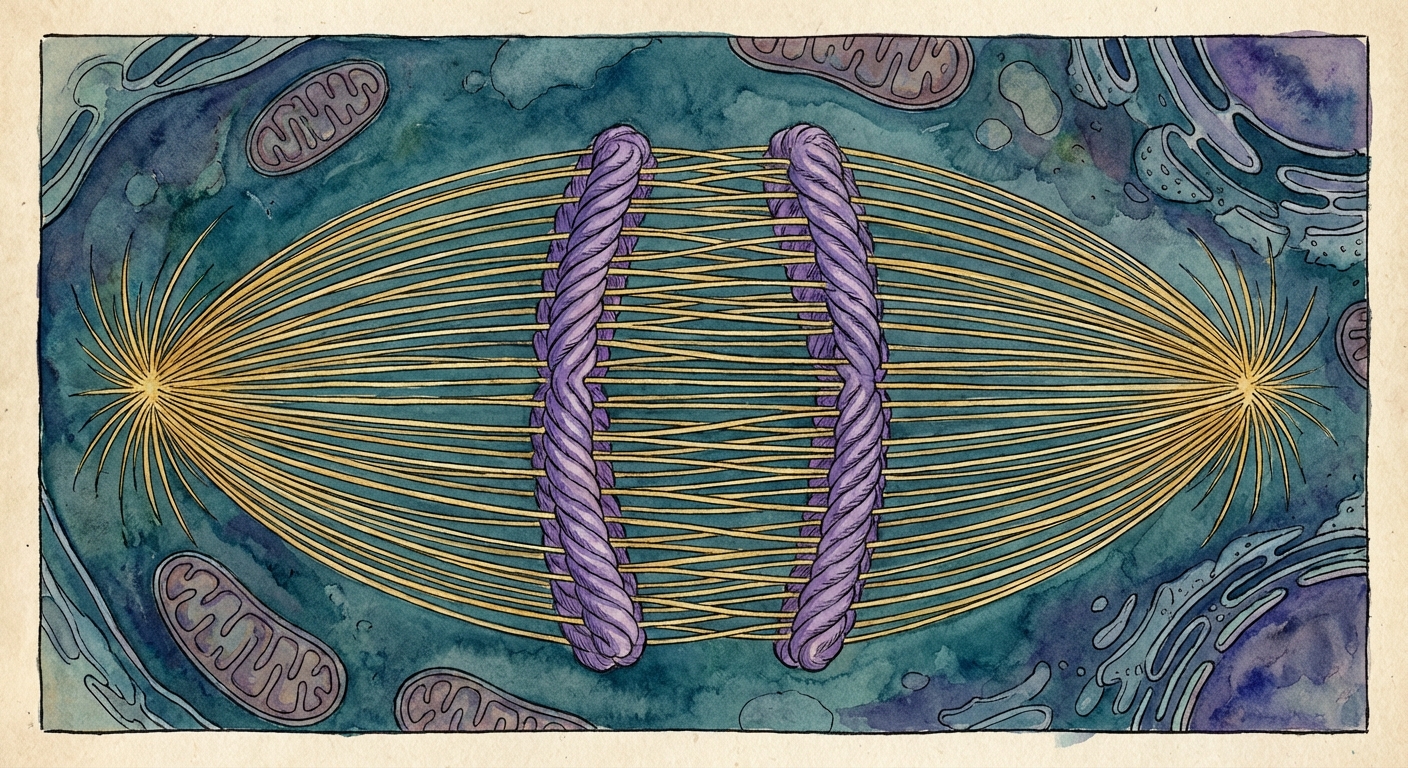
AI-generated illustration
Why it matters
Almost all animals and fungi use a single, specific point on a chromosome to pull it apart during cell division. Finding an organism that treats the whole chromosome as a centromere is extremely rare and suggests a complete, independent reinvention of the fundamental machinery of life.
From the abstract
During its asexual cycle, Cryptosporidium parvum (C. parvum) amplifies through three rounds of nuclear division before undergoing cytokinesis to form infectious merozoites. However, chromosome organization and segregation during nuclear division remain unstudied. Here, we visualized H3-histones, including the centromeric histone H3 (CENH3), telomeres, and centrosomes during mitosis. Nuclear division was accompanied by centrosome duplication and elongated microtubules that spanned the dividing nu