A wide variety of animals systematically delete large portions of their own DNA as they grow, meaning their bodies have less genetic information than their eggs.
March 31, 2026
Original Paper
Somatic Programmed DNA Elimination is widespread in free-living Rhabditidae nematodes
bioRxiv · 2025.08.21.671558
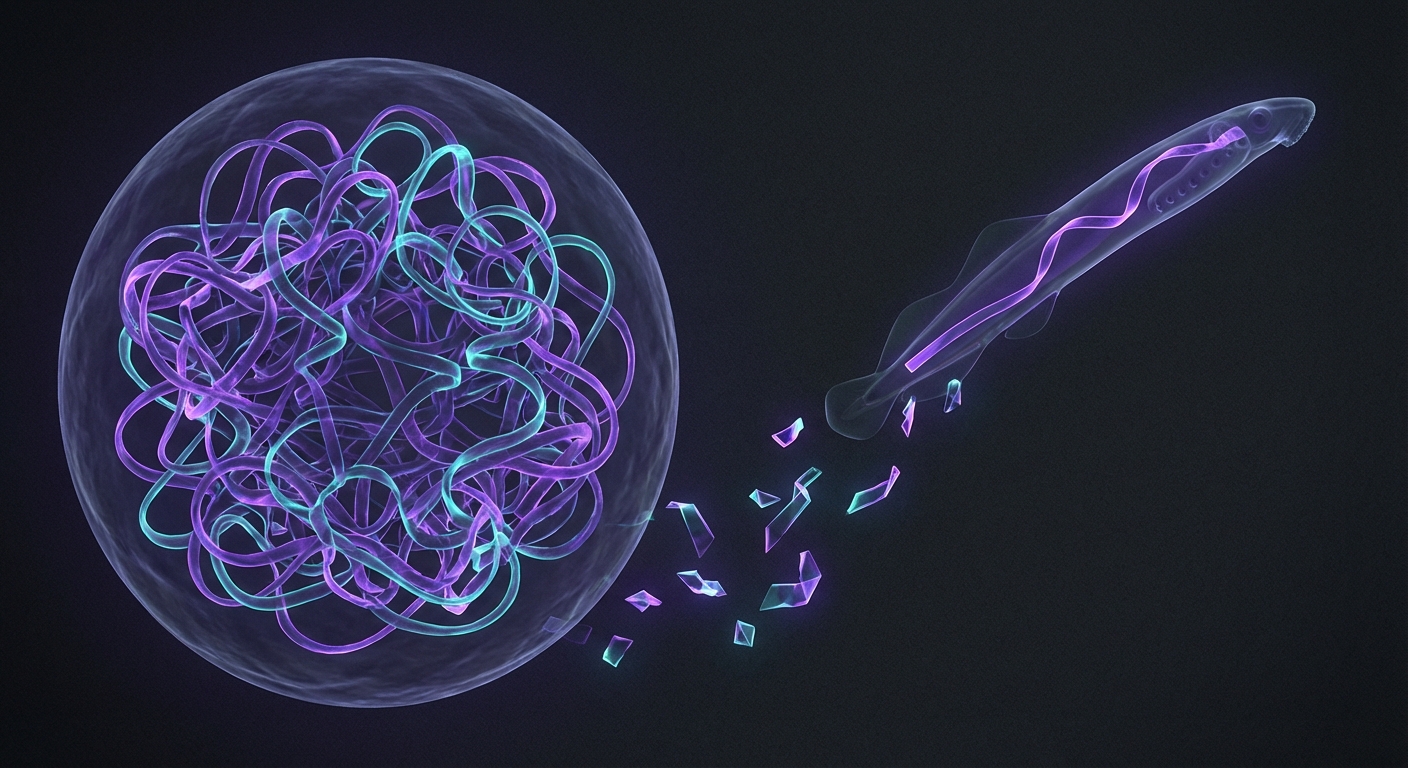
AI-generated illustration
The Takeaway
This challenges the fundamental biological dogma that every cell in an animal's body contains an identical copy of its DNA. The research reveals that many species 'clean up' their genome by permanently discarding sequences in their body cells, a much more common strategy than previously thought.
From the abstract
All cells of a multicellular organism usually share an identical genome, faithfully transmitted through successive divisions. Yet, a number of animal species deviate from this dogma, as parts of their DNA are systematically eliminated in all their somatic nuclei, in a process called Programmed DNA Elimination (PDE). PDE leads to the unexpected reorganisation of the genome at every generation in all somatic cells but its molecular mechanism, evolutionary origins, and functional significance remai