New measurements of the speed of distant supernovas suggest the universe might be curved like a giant ball rather than being perfectly flat.
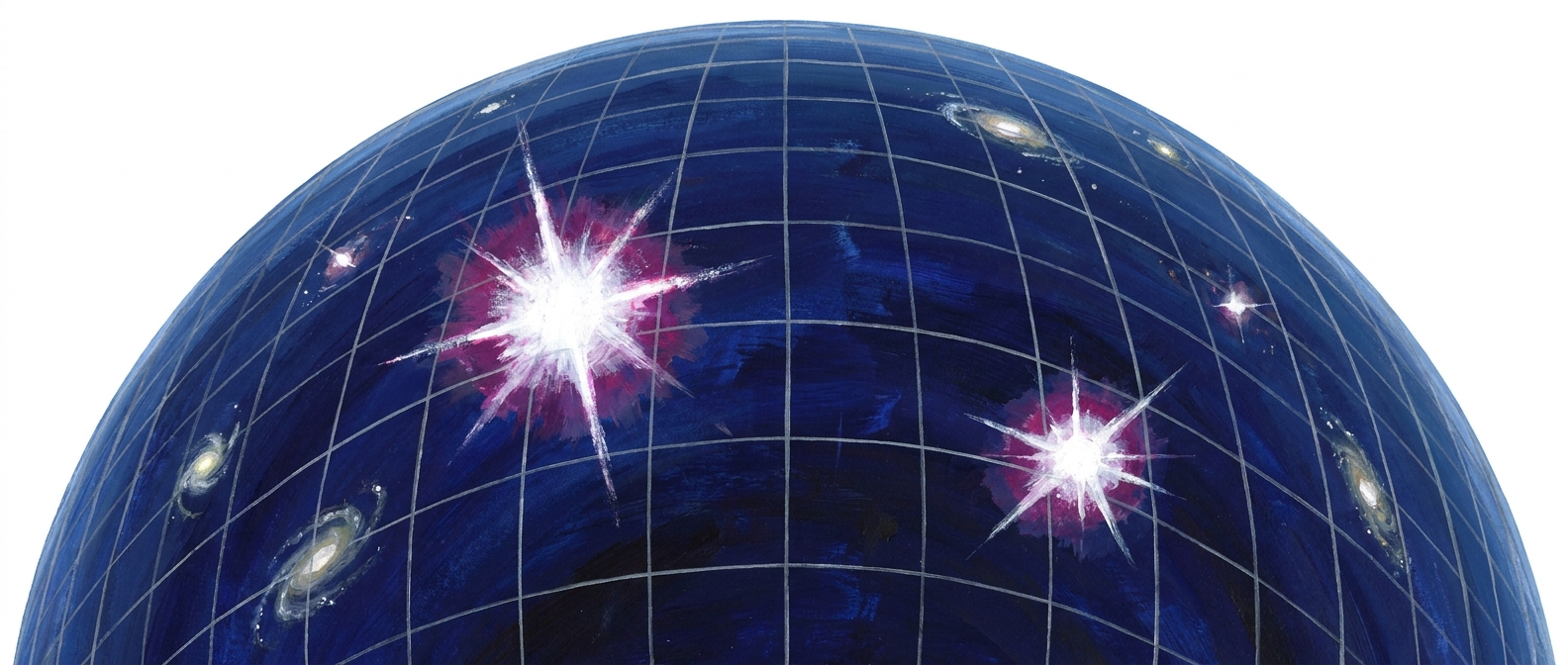
The idea that space is flat is a fundamental assumption that underpins almost everything we know about the cosmos. Data from the Cosmic Microwave Background and the movement of supernovas now points toward a positive spatial curvature. This shift in geometry implies that if you traveled far enough in one direction, you might eventually end up back where you started. A curved universe would require us to rethink the amount of matter and energy that exists in the void. It also changes our predictions for whether the universe will expand forever or eventually collapse.
Joint Curvature and Growth Rate Measurements with Supernova Peculiar Velocities and the CMB
SSRN · 6629542
Type Ia supernova (SN) magnitudes present correlations due to the fact that their peculiar velocities are sourced by the large-scale structure of the Universe. This can be used to constrain properties related to the distribution and growth of matter perturbations. We analyze both Pantheon+ and Dark Energy Survey (DES-Y5) SN catalogues in combination with CMB data from Planck PR4 to constrain $\sigma_8$, optionally including both curvature and a modified growth index $\gamma$. We show that SN and